


Interior painting and decorating is the finishing stage of a home: preparing surfaces, repairing plaster, applying paint or wallpaper to ceilings, walls and woodwork, and leaving the room clean. Done well, most of the effort goes into preparation, not into the final coat. What you pay depends on the room, the state of the surfaces and how much the painter has to repair first. The reliable way to hire is to compare itemised, fixed-price written quotes. This guide covers what the work includes, how plastering and painting fit together, what UK decorators typically charge, and how to protect yourself when you sign.
TL;DR
- A proper decorating job is mostly preparation: protecting the room, filling, sanding, cleaning and priming before any finish coat goes on.
- Fresh plaster needs time to dry, up to four weeks as a rule of thumb, then a watered-down mist coat before the topcoat.
- UK painter and decorator day rates have been reported anywhere from £120 to £400, with an average of £270 cited in 2023, so a quote should be a fixed total and not a day rate.
- Get at least three written quotes with a full breakdown, check VAT and ask about insurance before you say yes.
- If decorating is part of a bigger renovation, one contract covering building and finishing avoids gaps between trades.
Table of Contents
- What interior painting and decorating includes
- Plastering and decorating: how they work together
- Conditions that help paint dry and cure
- How long does it take?
- What painting and decorating costs in the UK
- Getting quotes you can rely on
- When decorating is part of a bigger project
- Decorating as part of a Torwood project
- Choosing a decorator: a checklist
- Planning around the rest of the house
- FAQ
- Sources
What interior painting and decorating includes
People use the phrase loosely. At its narrowest it means painting walls and ceilings. In a full service it usually covers several linked jobs:
- Preparation: moving or covering furniture, protecting floors, masking edges and sockets, removing old wallpaper or loose paint.
- Surface repair: filling holes and cracks, sanding, caulking gaps, and where needed patch plastering or skimming.
- Priming and sealing: the right primer or mist coat for the surface, particularly on new plaster, stained walls or bare timber.
- Painting: ceilings, walls, then woodwork such as skirting boards, doors, architraves and window frames.
- Wallcoverings and feature finishes: lining paper, wallpaper, panelling paint finishes and colour matching.
- Making good: removing masking, cleaning up and touching up.
The order matters. Wickes recommends painting the ceiling first, the walls second and the woodwork last, so that drips and cutting-in marks from the earlier stages are covered by the later ones. Its method runs through calculating materials, clearing and covering the room, filling and sanding defects, washing with sugar soap, protecting edges and sockets, cutting in with a brush and then rolling the main surfaces in smooth overlapping strokes.
Wickes also makes a point worth remembering when you judge a quote: paint will not take properly on dirty walls, and each coat should dry completely before the next goes on. A decorator who rushes either step is saving time at your expense.
Why preparation takes the time
Two rooms of the same size can differ enormously in effort. A sound, recently painted wall in a similar colour needs light cleaning and two coats. A Victorian room with cracked lath-and-plaster, layers of old wallpaper and flaking ceiling paint can need days of repair before the first coat. That is why a price per square metre or a guess from a photo is rarely reliable. A decorator who visits, looks at the walls and ceilings and asks about the condition of the plaster is doing the job properly.
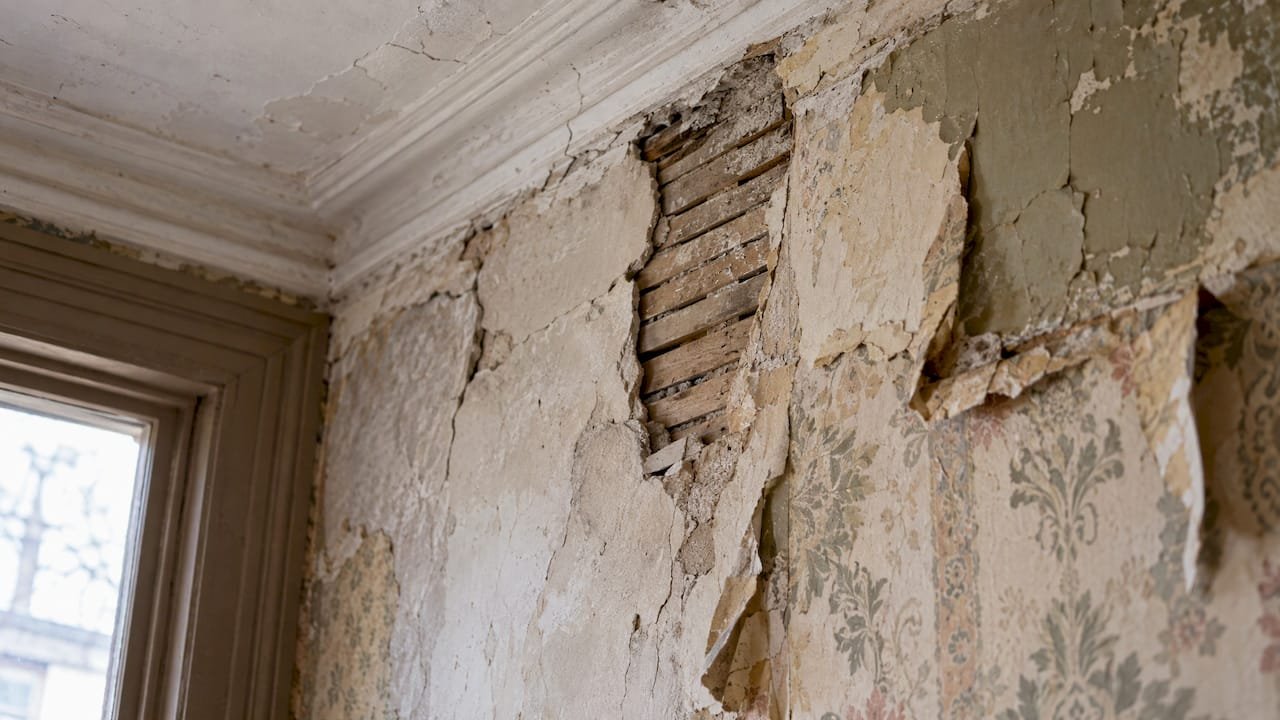
If you own an older property, our guide to Victorian house renovation explains what to check and keep before you decorate over problems that will come back.
Plastering and decorating: how they work together
Plastering and decorating are separate trades, but the quality of one decides the quality of the other. Paint shows every ridge, trowel line and patch. Where walls have been replastered, rewired or reboarded, the decorator inherits the plasterer’s finish and has to know when it is ready.
When can fresh plaster be painted?
Dulux advises that fresh plaster should dry properly before painting, up to four weeks as a rule of thumb. The usual sequence is then:
- Let the plaster dry fully. Patchy dark and light areas are a sign it has not.
- Apply a mist coat: standard emulsion thinned with water, which Dulux suggests at ten parts paint to one part water. It acts as a primer that the dry plaster can absorb.
- Let the mist coat dry.
- Fill or sand any flaws that show up.
- Apply the chosen topcoat as normal.
Wickes gives the same warning from the other direction: newly plastered walls should be completely dry before primer goes on. Painting too early traps moisture, and the result can be peeling, blotching or a weak bond.
What this means for your programme
If you are having rooms replastered, the drying period is the part people forget to plan. A decorator booked for the week after the plasterer finishes may have to wait, or may paint too soon. When one contractor manages both trades, the sequence can be planned around drying time instead of around two separate diaries. Ask any contractor how they handle the gap between plastering and the first coat.
Conditions that help paint dry and cure
Paint dries by evaporation and then cures over a longer period, so the room matters as much as the product. In practice:
- Keep the room ventilated while painting and afterwards, particularly in autumn and winter when windows are often shut.
- Keep the heating steady rather than blasting it. Rapid drying can affect the finish.
- Avoid painting walls that are damp, dirty or showing condensation. Fix the cause first, whether that is a leak, a failing seal or poor ventilation.
- Allow each coat to dry completely before recoating, and follow the tin’s guidance on recoat times.
The best time to paint indoors is when the surfaces are dry and clean and the room can be ventilated. When the walls are not in that state, painting is the wrong next step. Repair first.
How long does it take?
A single bedroom with sound walls can be a matter of days once drying between coats is included. A whole house takes longer and depends on how many decorators are on site, the amount of repair, the number of coats and whether woodwork needs undercoat and gloss. We would not give you a single figure for a three-bedroom house, and you should be wary of any contractor who does so without seeing it.
What you should expect is a written programme: which rooms in which order, when furniture needs to be moved, and when each room will be usable again. Winter jobs and dark-to-light colour changes usually need more time, so build in some slack.
What painting and decorating costs in the UK
Prices vary by region, property and finish, and published figures date quickly. As a reference point, LoveProperty reported in February 2023 that the average UK day rate for a painter and decorator was £270, citing Checkatrade figures, while HaMuch reported rates ranging from £120 to £400 a day. London and the South East tend to sit higher than the national average, and prices will have moved since 2023, so treat these as a guide to the spread, not a budget.
What drives the price of a room:
| Factor | Effect on cost |
|---|---|
| Size and ceiling height | More surface, more scaffold or tower time, more paint |
| Condition of walls and ceilings | Repairs, skimming and extra coats add days |
| Woodwork | Doors, skirting and windows need sanding, undercoat and gloss |
| Colour change | Dark to light often needs extra coats or a stain-blocking primer |
| Wallpaper | Stripping, lining paper and hanging are priced separately |
| Furniture and access | Occupied rooms take longer to protect and clear |
| Paint specification | Washable, kitchen and bathroom paints cost more |
A day rate is a way to understand a decorator’s pricing, not a way to buy. What you want on paper is a fixed total.
Getting quotes you can rely on
Citizens Advice recommends getting at least three written quotes, each with a fixed total price rather than a day rate, a full breakdown of work and materials, and a statement of whether VAT is included. Comparing like for like is only possible when each quote lists the same rooms, the same preparation and the same number of coats.
The same principle applies to any made-to-measure finishing in a room, such as window dressings. An itemised quote that separates materials, measuring and fitting is what lets you compare, and shutter materials, costs and checks show how that breakdown looks for one product.
What a good quote lists
- Each room and surface covered, including ceilings and woodwork
- The preparation included, such as filling, sanding and mist coating
- Paint brand, type and number of coats
- What is excluded, such as wallpaper stripping or plaster repairs beyond a stated size
- Start date, duration and payment stages
- Whether VAT is included
What the quote means legally
Citizens Advice states that a quote is a fixed price: the trader cannot charge more unless you agree to extra work or they made a genuine mistake in writing or calculating the price. It also says that once you say yes, it is a binding agreement, whether or not it is written down. So write it down, and read it before you accept.
Insurance and cancelling
Citizens Advice advises checking your own buildings insurance and asking what insurance the trader holds: public liability, employers’ liability if they have employees, and professional indemnity if there is technical design work. For decorating, public liability is the cover that matters if a ladder goes through a window or paint damages a floor.
If you sign at home or online, you may have a 14-day cooling-off period to cancel. If you ask the trader to start work within that period, you may be liable for the costs incurred. Agree the start date with that in mind.
When decorating is part of a bigger project
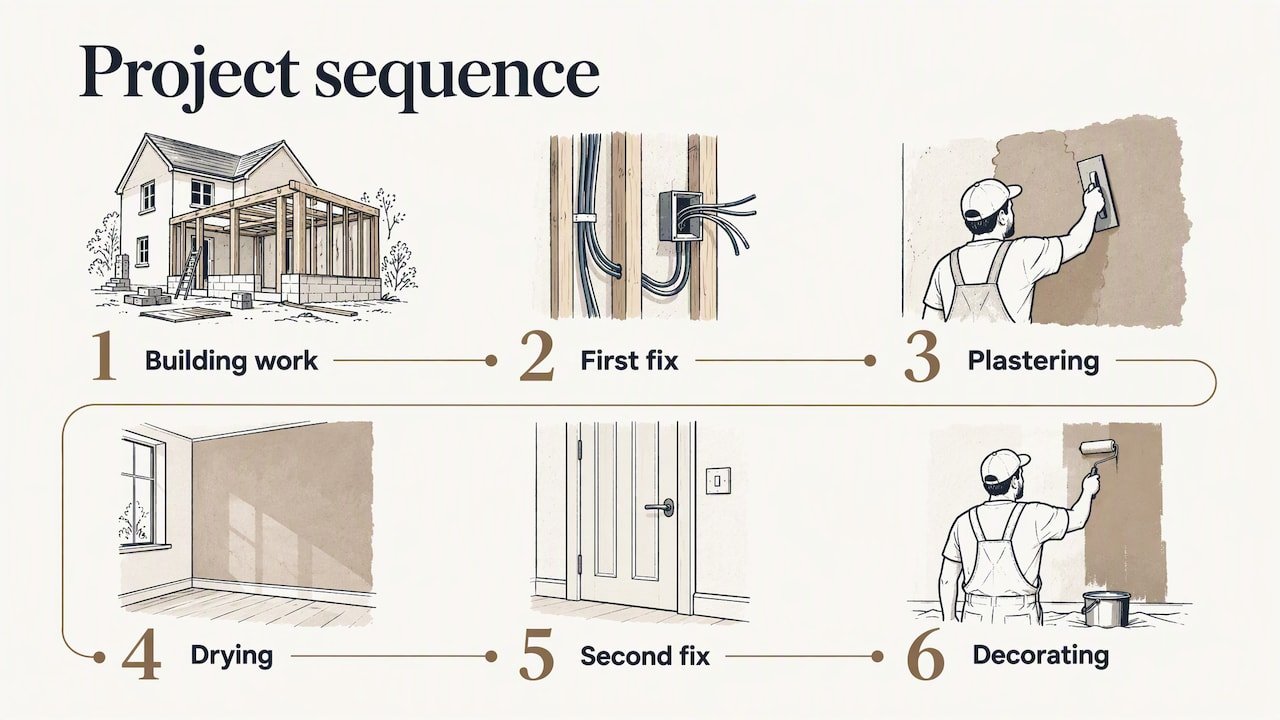
Most of the decorating we see is not a standalone job. It is the last stage of an extension, a loft conversion, a bathroom or a full refurbishment. In those cases the paint is only as good as what comes before it: plaster that has dried, joinery that has been fitted and sanded, and electrical and plumbing work that is finished so nobody cuts into a freshly painted wall.
The sensible order is building work, first fix, plastering, drying, second fix, then decorating. Bring the decorator in too early and you pay for repairs. Bring them in too late and the programme drifts. Our guides to bathroom renovation and bedroom interior design show where finishing sits in those projects.
Our perspective
We rarely see a decorating problem that started with the paint. It usually started earlier: plaster painted before it was dry, a wall with a damp cause nobody fixed, or joinery fitted after the decorator had finished.
That is why we run decorating as part of the build and not as a separate booking. The director manages each project personally, so the person who knows what the plasterer did and when the walls will be ready is the same person who decides when the decorators start. The construction, the coordination with architects and designers, and the bespoke detailing sit under one contract.
For a homeowner, that means one point of contact and one written scope, and no argument between trades about whose fault a cracked ceiling line is. We would rather give you a programme with drying time built in than a quick start that you pay for twice.
Our advice is simple: judge a decorating quote by how much it says about preparation. The finish coat is the easy part.
raimundas
Decorating as part of a Torwood project
We are builders and bespoke joiners working across South London and Surrey, and we handle interior finishing as part of extensions, loft conversions and refurbishments. Everything is managed from consultation and design through construction to handover, coordinated with your architect or designer where you have one.

If you are planning work that will need plastering and decorating, you can see what we do on our services page, read about property refurbishment, or request a building quote. Our quotations are written per project, with staged payments set out in the contract. For ongoing upkeep of a property, our maintenance service covers smaller jobs.
Choosing a decorator: a checklist
- Visit before pricing. Anyone quoting without seeing walls and ceilings is guessing.
- Compare scope, not totals. The cheapest quote often leaves out preparation.
- Ask about drying and recoat times and how they are built into the programme.
- Check insurance and ask for the certificate.
- Get it in writing: fixed price, rooms, coats, exclusions, VAT, dates and payment stages.
- Ask who is on site. Know who supervises and who to call.
- Agree how extras are handled before work starts, so changes are priced and agreed in writing.
A tradesperson who answers these without hesitation is usually one who has a system. One who avoids them is telling you something too.
Planning around the rest of the house
Decorating is also the point where budgets get tested. People spend on structure and then squeeze the finish. For an extension or conversion, plan the decorating allowance at the start, not at the end. Our guides to single-storey extension costs and the loft conversion cost guide explain how to budget the whole job, including VAT and quotes. If you are weighing up a wider project, our overview of planning a home renovation in South London is a good place to begin.
If you can, decorate in stages. Finish the rooms that disturb the rest of the house least first, and leave stairs, hallways and any room that will take furniture deliveries until last. It saves repainting scuffs.
FAQ
What do painters and decorators charge per day?
Reported UK rates run from about £120 to £400 a day, and an average of £270 was cited in February 2023 from Checkatrade figures, according to LoveProperty. Rates are higher in London and the South East and have probably risen since. Ask for a fixed total price in writing, not a day rate.
How long should fresh plaster dry before painting?
As a rule of thumb, up to four weeks. Then apply a mist coat of emulsion thinned at ten parts paint to one part water, let it dry, fill or sand any flaws and apply the topcoat. Painting before the plaster is dry risks peeling and patchiness.
When should you not paint indoors?
Do not paint over dirty, damp or condensation-affected walls, or over new plaster that is not fully dry. Wickes advises that paint will not take properly on dirty walls. Fix the damp or ventilation cause first, then clean, and allow every coat to dry before the next.
What should a decorating quote include?
A fixed total price, a breakdown of work and materials, and whether VAT is included, as Citizens Advice recommends. Also look for the preparation included, number of coats, exclusions and dates. Get at least three so you can compare like for like.
Sources
- How to Paint a Room | Wickes
- Dr Dulux: How To Paint New Plaster | Dulux
- Before you get work done on your home | Citizens Advice
- Cancelling building or decorating work | Citizens Advice
- Painter near me? How much a painter and decorator costs | LoveProperty